

Stop Cooking Your Jacksonville Home From the Top Down
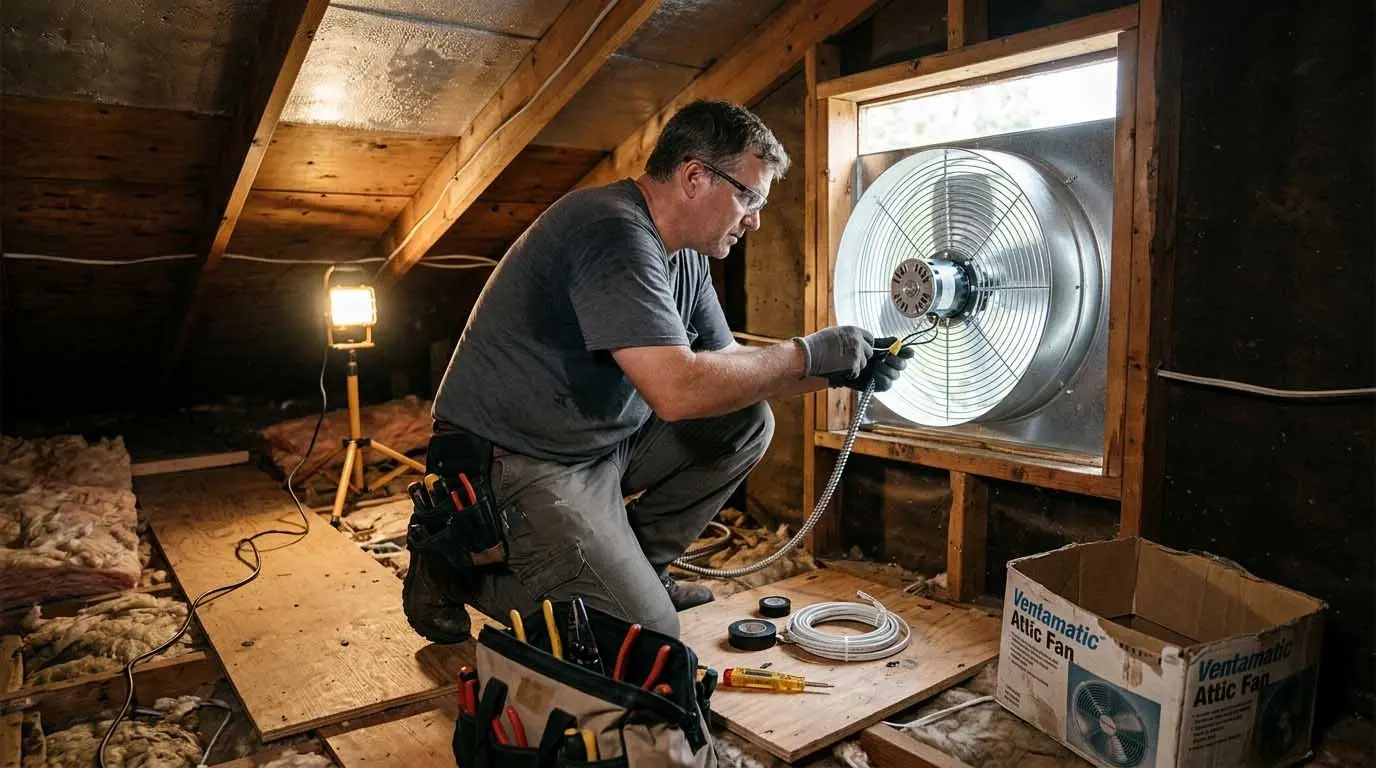
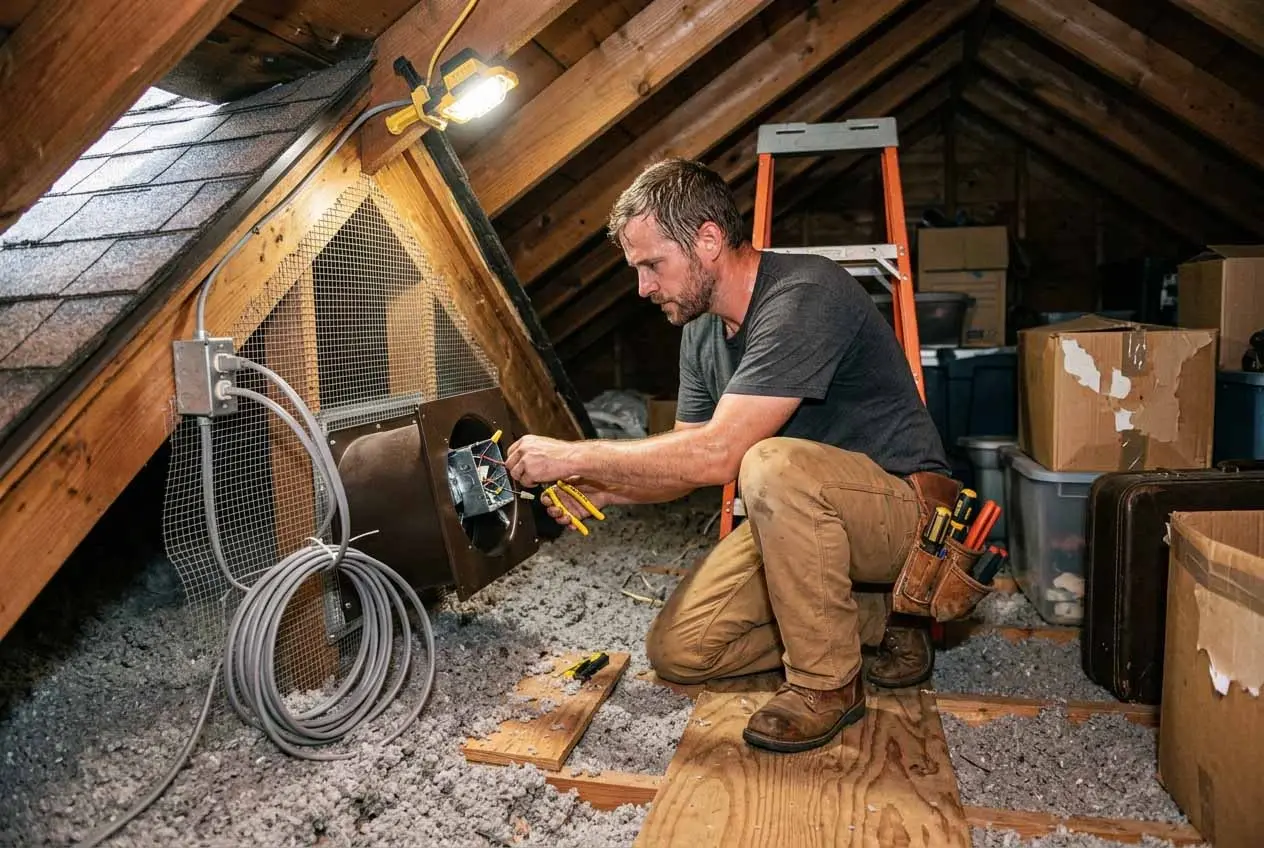
Walk into your attic on a July afternoon in Jacksonville. If you feel a wall of heat that forces you back down the pull-down stairs, your home has a problem. That 130-150°F air sits directly above your ceiling insulation, slowly heating your drywall, your ductwork, and every room below. Your air conditioner fights this heat all day while you pay for the battle. Attic fan installation solves this by pulling that superheated air outside before it ever seeps into your living space. Our team installs attic exhaust fan systems on gable vents, through roofs, and even solar attic fan units that need no household electricity. We also perform gable fan replacement when old units seize up or become too loud to tolerate.
Five Signs Your Attic Needs an Exhaust Fan
First, your upstairs bedrooms are always warmer than the main floor even with the AC running. Second, your monthly cooling bills have climbed every summer despite no change in usage. Third, you notice curling asphalt shingles or premature aging of your roof deck — heat damage from below. Fourth, your attic insulation feels hot to the touch in August when your home should be cool above the insulation line. Fifth, your pull-down attic stairs or ceiling access hatch radiates noticeable warmth into your hallway. Each of these signs indicates trapped heat that an attic exhaust fan would remove. During our attic fan installation, we calculate your required CFM attic calculation using a simple formula: attic length × width × height × 0.7 for a standard roof pitch. A 1,500 square foot attic with 8-foot ceilings needs roughly 8,400 CFM of fan capacity. We match fan size to this number — not bigger, not smaller. Oversized fans without proper soffit vent balance create negative pressure that pulls cooled air from your living room into the attic.
Every attic fan installation we complete in Jacksonville follows this sequence:
- Attic volume measurement and CFM attic calculation to determine correct fan size
- Soffit vent balance inspection — counting existing soffit vents and measuring net free area
- Selection between roof mount fan (through shingles) or gable fan (through wall) based on your home's architecture
- For gable fan replacement, removal of old unit and fitting new housing into existing opening
- For solar attic fan, mounting of solar panel on southern roof exposure and fan unit on gable or roof
- Thermostat setting attic configuration at 100-110°F with adjustable differential
- Installation of humidistat attic fan control for homes with high indoor humidity or bathroom fans venting into attic
- Freeze stat installation to prevent winter operation when attic is below 50°F
- Flashing and sealing of roof mount fan penetration with ice and water shield
How Long Does Attic Fan Installation Take?
A gable fan replacement where an existing unit is already mounted and the wiring is in place takes 2 to 3 hours. Most of this time is spent removing the old fan, modifying the mounting frame if the new fan has different dimensions, connecting wires, and testing thermostat setting attic response. A new gable fan installation in a home that has never had one requires 4 to 5 hours. This includes cutting a hole through the gable wall, framing the opening, mounting the fan, running electrical wire from the nearest available circuit or attic light fixture, installing a switch and thermostat, and sealing the exterior louver. A roof mount fan installation takes 5 to 7 hours because we must work on the roof slope, cut a hole through sheathing and shingles, install a flashing flange that will not leak, run wire down through the attic to the fan location, and configure both thermostat setting attic and freeze stat. Solar attic fan installation is the quickest at 2 to 3 hours because there is no wiring to your panel — we mount the solar panel on the south-facing roof slope, mount the fan unit on the gable or roof, and connect the two with low-voltage wire. However, solar attic fan effectiveness depends on Jacksonville sun exposure. North-facing roof slopes get little sun, and heavy tree cover reduces performance. We test solar irradiance at your address before recommending a solar unit. For clients with complex Jacksonville roof lines or multiple gables, we may install two smaller fans rather than one large unit to ensure balanced airflow without overloading any single vent location. The most labor-intensive scenario is a home with no existing soffit vent balance. We cannot install an attic exhaust fan without enough intake venting. In this case, we coordinate with a roofer to add soffit vents or install low-profile intake vents near the eaves before our attic fan installation. That project requires two visits and typically 1-2 days total, but we disclose this upfront during our free site assessment.

Why Soffit Vent Balance Determines Whether Your Fan Helps or Hurts
Here is the mistake that ruins most attic fan installations: installing a powerful attic exhaust fan without enough intake vents. Your soffit vent balance is the ratio of intake vent area (soffits, eave vents) to exhaust vent area (gable fan, roof mount fan). Proper balance requires at least 1 square foot of net free intake area for every 300 CFM of exhaust fan capacity. If your soffit vents are clogged with paint, blocked by insulation, or simply never installed, your attic exhaust fan will pull air from the only available source — your home. It will suck conditioned air through ceiling can lights, around attic hatches, and through unsealed wire penetrations. Your air conditioner will run longer, not shorter. Your electric bill will rise. Your comfort will decrease. We measure your existing soffit vent balance during our attic fan installation assessment using a simple calculation: count every soffit vent, measure its dimensions, calculate net free area (typically 50-70% of gross area for standard stamped vents). If intake is insufficient, we recommend adding soffit vents before proceeding. For homes with fixed roof lines where soffit vents cannot be added, we install a smaller attic exhaust fan or switch to a roof mount fan with integrated intake louvers. Regarding thermostat setting attic, we configure your fan to activate at 100-110°F and deactivate at 85-90°F. This keeps the fan off during mild spring and fall days while ensuring it runs during peak summer heat. For homes with seasonal humidity issues, we add a humidistat attic fan control that also triggers the fan when relative humidity exceeds 60%, preventing mold growth on roof sheathing regardless of temperature. The freeze stat is a simple temperature switch that locks the fan off when attic temperature drops below 50°F. Without it, your attic exhaust fan could run on a 45°F winter day, pulling your expensive heated air up into the attic and out through the fan. Every attic fan installation we complete in Jacksonville includes all three controls: thermostat, humidistat (if needed), and freeze stat. We also provide a one-page diagram showing your soffit vent balance measurements, CFM attic calculation, and control settings for your records.
Call our team in Jacksonville to schedule your attic fan installation assessment. We measure first, then recommend equipment that works with your home — not against it.