

Bathroom Exhaust Fan Installation That Actually Removes Moisture
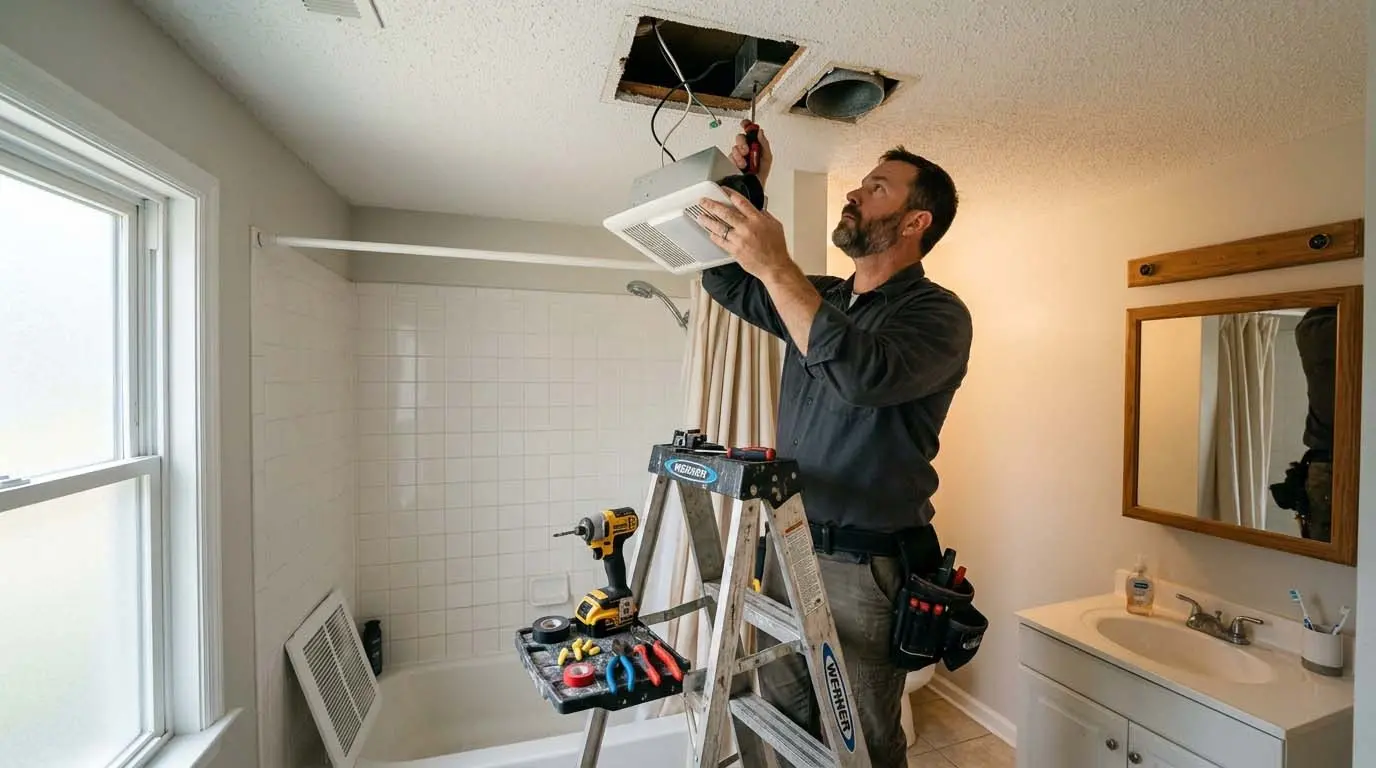
A bathroom fan should clear steam within 15 minutes after a hot shower. Most older fans in Jacksonville homes take 45 minutes or never clear the mirror at all — meaning moisture is soaking into your drywall, ceiling paint, and wooden vanity. Our bathroom exhaust fan installation service fixes this permanently. We handle bathroom fan replacement for noisy, weak, or broken units, and we install new ventilation fan installation in bathrooms that never had one. Many homeowners in Jacksonville are surprised to learn their existing fan blows directly into the attic instead of outside — a dangerous code violation we correct with proper exhaust fan ducting through a roof cap, gable end, or soffit vent termination.
Three Signs Your Bathroom Fan Is Failing
First, your fan runs but nothing happens. You hold a tissue near the grille and it barely moves. That indicates a clogged duct, a disconnected duct, or a motor spinning without moving air. Second, the fan sounds like a lawnmower. A grinding or rattling noise usually means worn bearings that will seize completely within months. Third, you see condensation on walls or peeling paint despite running the fan. This means either the CFM rating is too low for your bathroom size, or the duct has holes leaking air into your ceiling cavity. We diagnose each scenario during your service call. For undersized units, we calculate the correct CFM rating based on your bathroom square footage (1 CFM per square foot minimum, 1.5 CFM for bathrooms with large jetted tubs or steam showers). For noise complaints, we recommend models with low sone rating — 1.0 or quieter, comparable to a refrigerator hum. For bathrooms that feel cold after showers, we install a bathroom fan with light and heater combination unit that warms the room while exhausting moisture.
Every bathroom exhaust fan installation we complete includes these steps:
- Measurement of your bathroom dimensions to calculate required CFM rating (formula: length × width × height ÷ 7.5)
- Inspection of existing ductwork to confirm it terminates outside, not in the attic or soffit cavity
- Selection of appropriate fan type: basic ventilation fan installation, bathroom fan replacement of same size, or retrofit installation of new unit into old ceiling hole with adapter kit
- Exhaust fan ducting using rigid metal pipe (not flexible foil) for smooth airflow and less noise
- Installation of roof jack or wall cap with backdraft damper so cold air does not fall back into the fan
- Wiring to dedicated GFCI-protected circuit or tapping existing bathroom lighting circuit per code
- For humidity sensing fan models, programming the activation threshold and run time after humidity drops
- Testing with smoke pellets to confirm air moves fully outside the home
How Long Does Bathroom Exhaust Fan Installation Take?
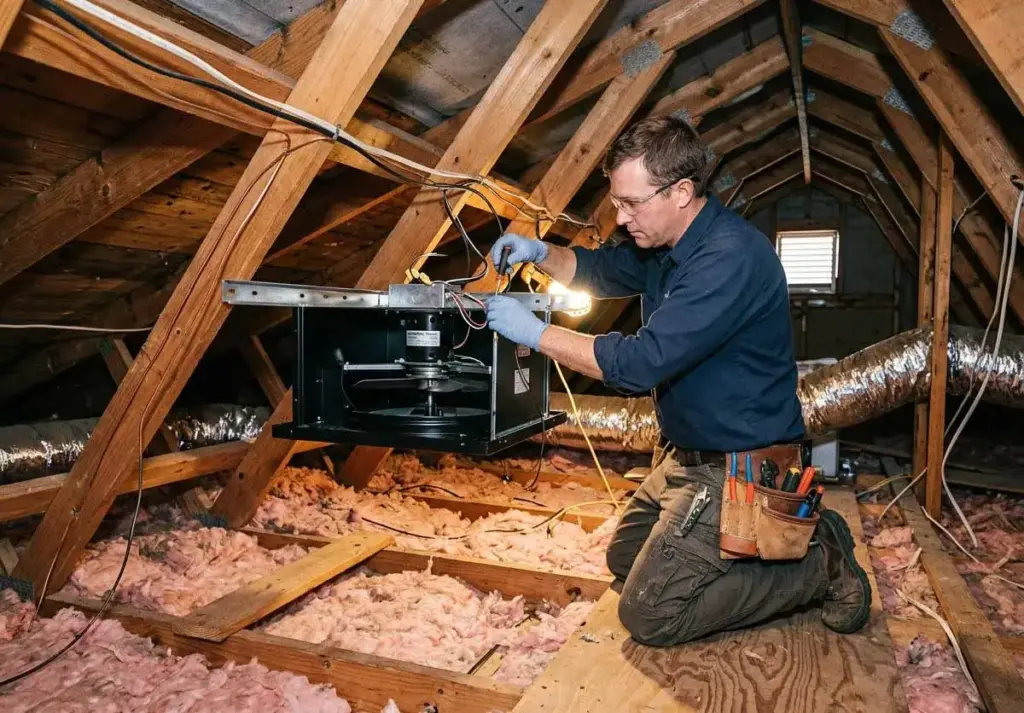
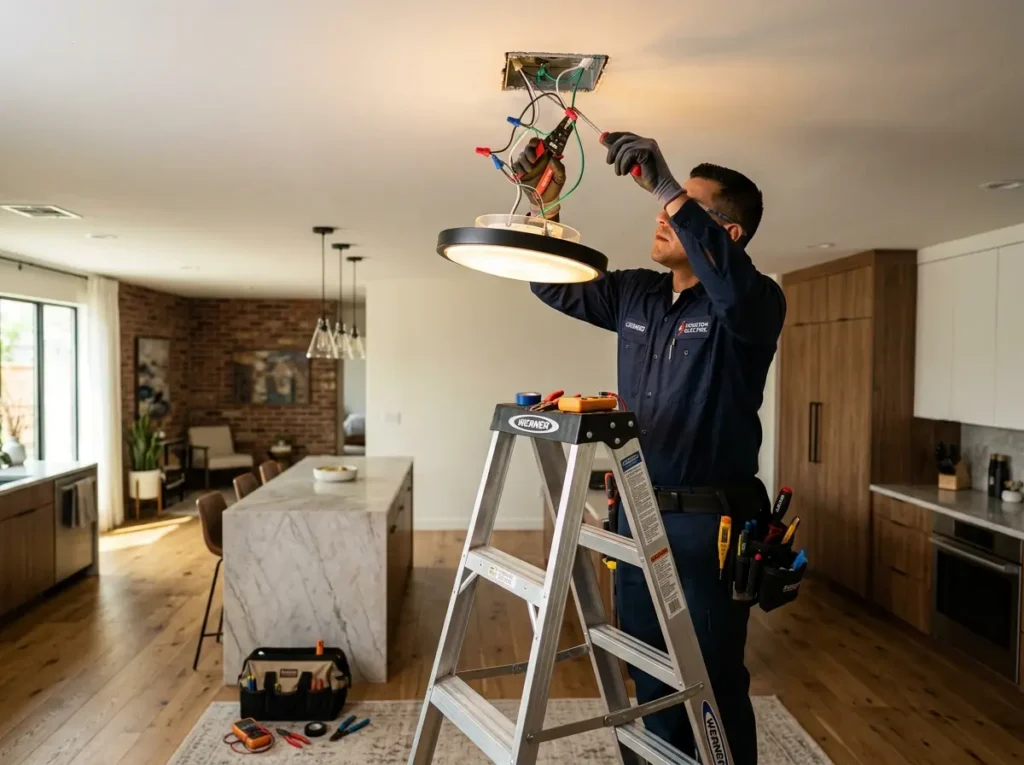
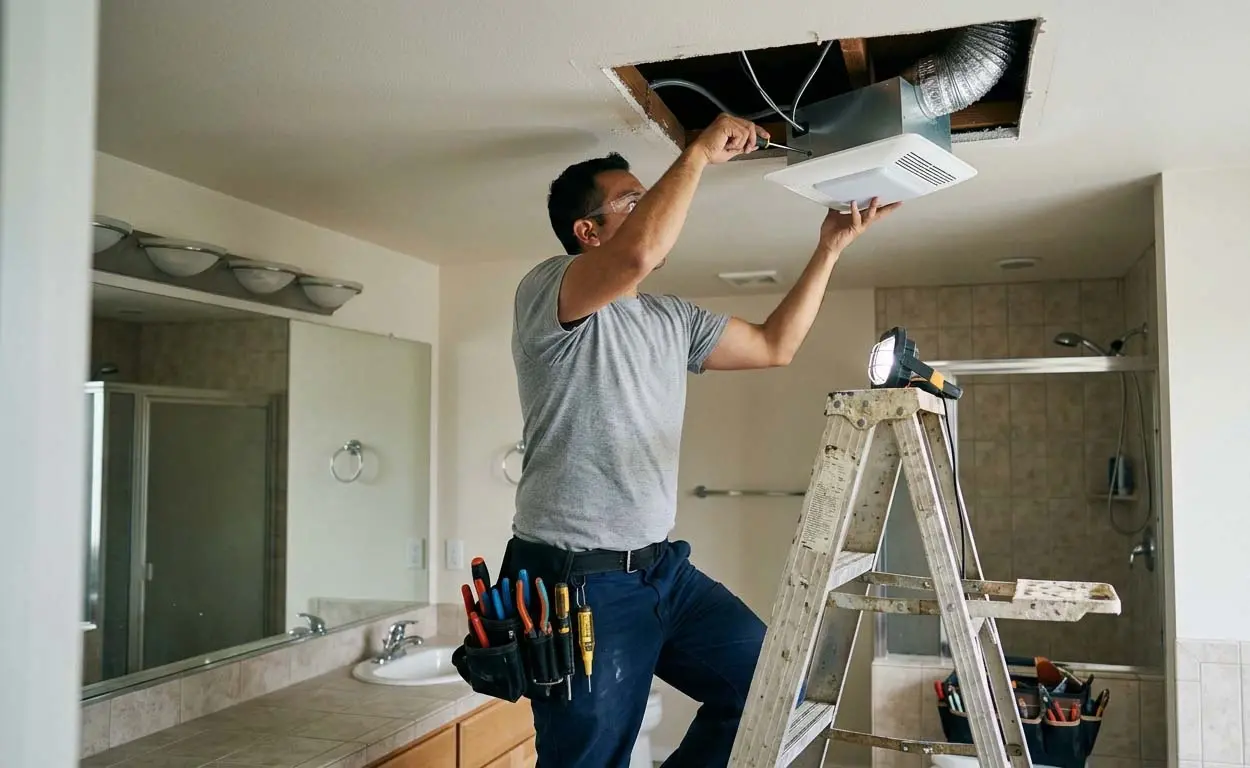
A simple bathroom fan replacement where the new unit fits the existing ceiling opening and the old ductwork is already correctly terminated outside takes 2 to 3 hours. Most of this time is attic work: disconnecting the old fan, removing it, mounting the new housing, reconnecting the duct, and making electrical connections. A retrofit installation where the new fan has a different size or shape than the old hole adds 1 to 2 hours for ceiling modification, patching, and texturing. If your bathroom never had a fan before — meaning no existing duct, no switch, and no ceiling hole — expect 4 to 6 hours. This includes cutting a new ceiling opening, running exhaust fan ducting from the fan location to a soffit vent termination or roof cap, fishing wire from the switch to the fan, installing a new wall switch, and patching any access holes we cut. For a bathroom fan with light and heater unit, add 1 to 2 hours because these units require additional wiring for the heater circuit (often a dedicated 20-amp line) and a multi-function switch (light, fan, heater separately controlled). The most time-consuming scenario in Jacksonville is replacing a fan that illegally vents into the attic. We first remove the old duct, patch any roof or wall openings that were not finished, then run new exhaust fan ducting to a proper termination. That project typically takes 5 to 7 hours. We always provide a written estimate with two timeline options: basic replacement or full correction of code violations.
Why CFM Rating and Sone Rating Matter More Than Brand Name
Homeowners often buy the cheapest fan at the hardware store or the fan with the brightest LED light. Neither choice fixes moisture problems. The critical numbers are CFM rating and sone rating. CFM rating tells you how much air the fan moves. A fan rated for 50 CFM in a 100 square foot bathroom is mathematically incapable of clearing steam regardless of brand or price. We calculate your actual need: a 40 square foot powder room needs 50 CFM minimum. A 100 square foot master bath with a separate shower and soaking tub needs 110 to 150 CFM. A bathroom with a steam shower unit needs 200+ CFM or a second fan. Sone rating tells you how loud the fan is. A fan rated at 4 sones sounds like a loud conversation. At 1.5 sones, you can watch a video while the fan runs. At 0.5 to 1.0 sones (Panasonic, Delta Breez), you may not hear it at all. Our bathroom exhaust fan installation includes a consultation on both ratings before you buy any equipment. For clients who already purchased a fan, we test its actual CFM rating post-installation using an airflow hood to verify performance matches the box. Regarding exhaust fan ducting, we use rigid metal pipe exclusively. Flexible foil duct reduces airflow by 30-50%, traps lint and dust, and can sag, creating low spots where moisture collects. Rigid metal 4-inch or 6-inch duct maintains full airflow, resists crushing, and does not harbor mold. We terminate every exhaust fan ducting run at a soffit vent termination, gable vent, or roof cap with a spring-loaded backdraft damper. The damper prevents cold Jacksonville winter air from dropping down into your fan and dripping condensation onto your ceiling. For homes with finished ceilings below and no attic access above, we perform retrofit installation using a hole-cutting template and mounting the fan entirely from inside the bathroom — no attic crawl required. Every ventilation fan installation we complete includes a final smoke test where we place a smoke pellet below the running fan and watch the entire smoke plume exit the outdoor termination within 10 seconds.
Call our team in Jacksonville to schedule your bathroom exhaust fan installation. We clear steam fast, run quietly, and terminate outside — exactly how code requires and your bathroom deserves.