

The Solar Attic Fan That Pays for Itself — No Wiring, No Electric Bill
A traditional attic exhaust fan lowers your attic temperature but adds to your electric bill. The motor spins your meter while trying to save you money. Our solar attic fan solves this contradiction. The solar panel mounts on your Callahan south-facing roof slope, the fan pulls hot air from your attic, and your AC runs less—all for free after installation. We perform solar attic fan installation for homeowners who want zero operating cost, no wiring to the panel, and a fan that runs exactly when the sun is hottest (when your attic needs it most). For homes where solar is not practical (shaded roofs, north-facing slopes), we install electric roof mount fan or gable fan replacement units with efficient DC motors that use 80% less power than old AC units.
Four Attic Ventilation Problems Solar Solves
Problem one: electric attic exhaust fan operating costs offset the savings. A 300-watt fan running 8 hours a day costs $0.30/day ($90/year) in Callahan electricity rates. A solar attic fan costs $0. Problem two: wiring challenges. Many older homes have no attic power, requiring a new circuit from the panel. Solar attic fan needs no wiring — just mount and connect low-voltage wire. Problem three: thermostat setting attic that fails. Electric fans rely on thermostats that can stick open or closed. Solar fans run whenever the sun shines — no thermostat to fail. Problem four: freeze stat and humidistat attic fan complexity. Electric fans need additional controls to prevent winter operation and respond to moisture. Solar fans naturally shut off at night and on cloudy days, and they do not run in winter because the sun is low and days are short.
Our attic fan installation process in Callahan matches the fan type to your home's exposure:
- We measure your roof's solar exposure using a solar pathfinder or satellite imagery — south-facing slopes with minimal shading get solar attic fan recommendation
- We calculate CFM attic calculation for your attic volume (cubic feet ÷ 300 for solar, since solar fans run fewer hours than electric)
- We verify soffit vent balance — even solar fans need intake vents to avoid pulling air from the house
- For solar attic fan, we mount the solar panel on the south-facing slope, drill a small hole for low-voltage wire, and mount the fan on the gable or roof
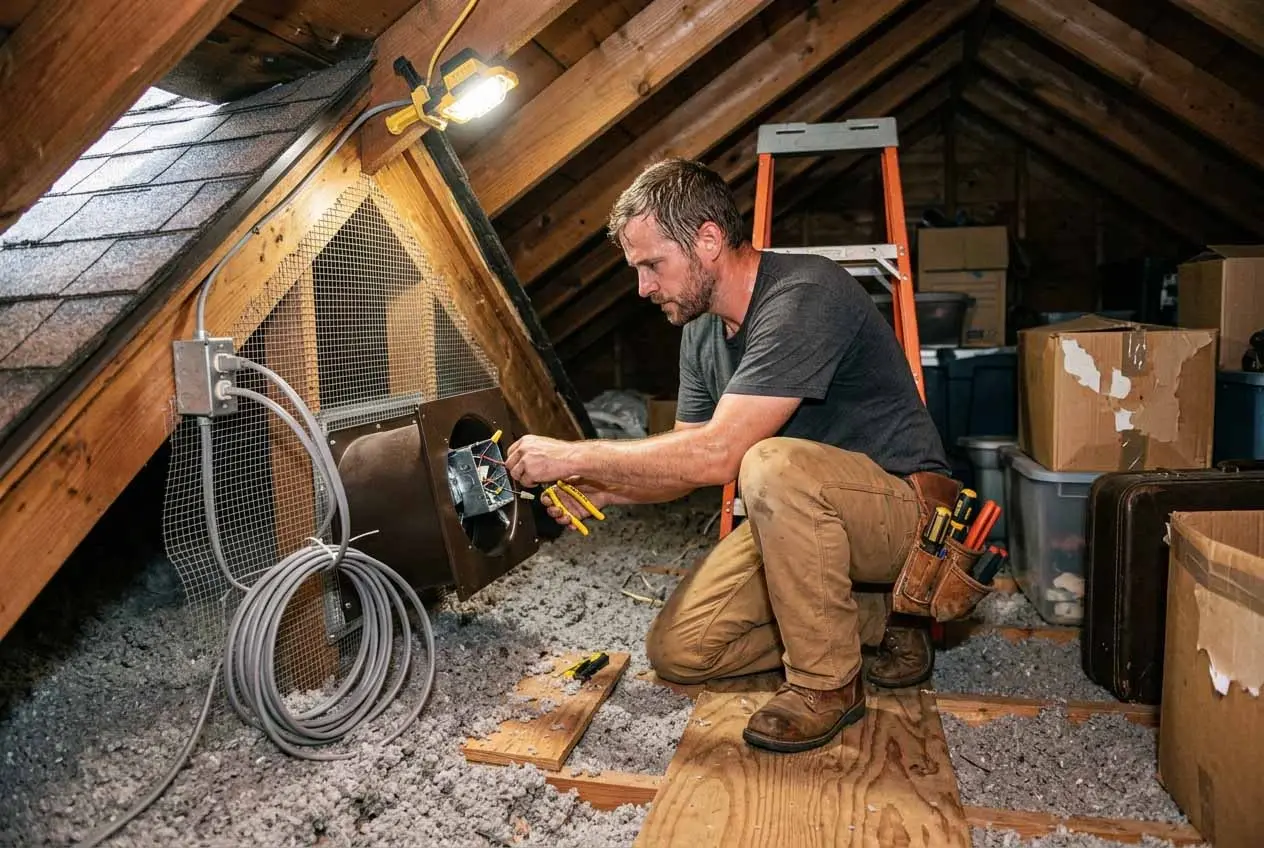
- For electric roof mount fan, we run 14/2 Romex from an attic light or outlet, install a thermostat setting attic at 100°F, and add freeze stat
- For gable fan replacement, we swap the old fan and connect to existing wiring, updating controls if needed
- For any attic fan, we seal all roof penetrations with flashing and ice-and-water shield — no leaks guaranteed
How Long Does Attic Fan Installation Take?
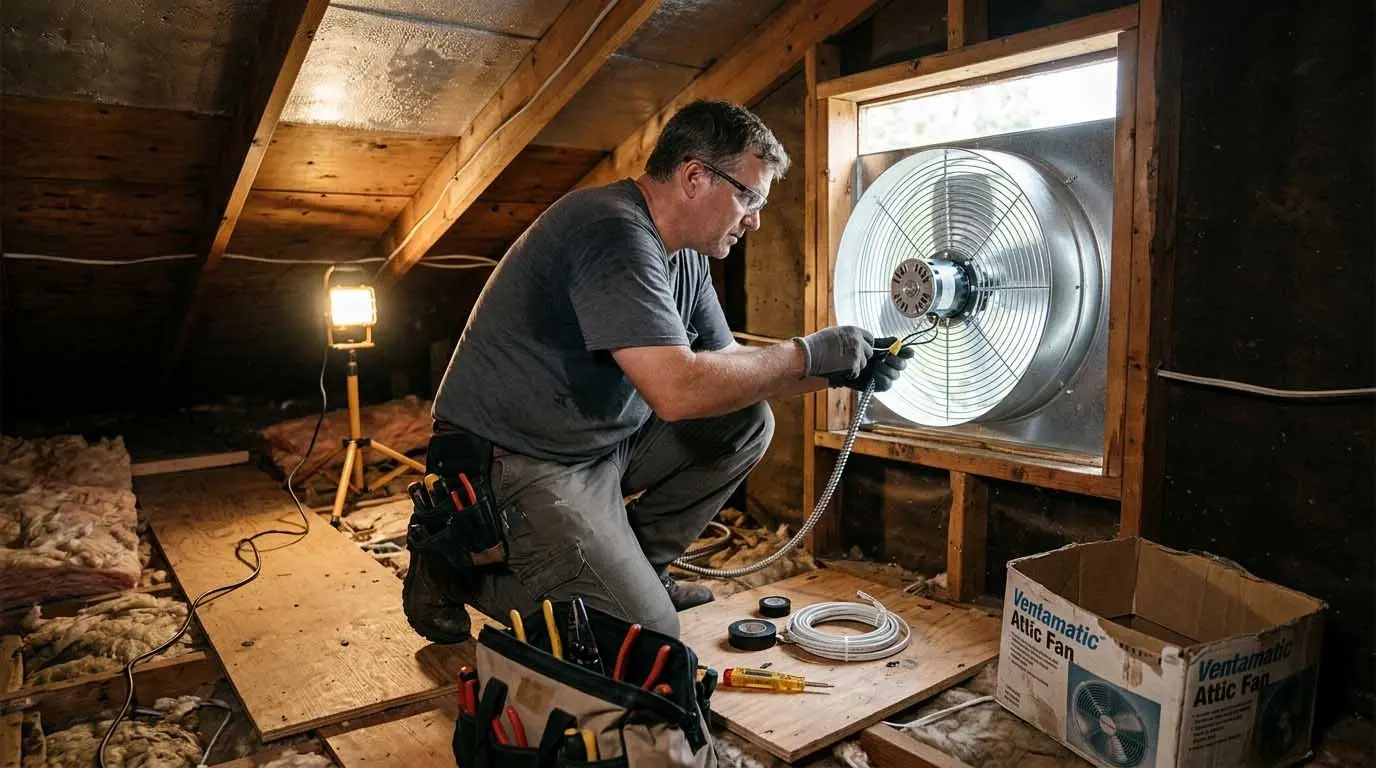
A solar attic fan installation where the roof has good southern exposure and the soffit vent balance is adequate takes 2 to 3 hours. We mount the solar panel (two screws into rafters), drill a small hole for low-voltage wire, mount the fan on the gable or roof, connect the wire, and test that the fan runs in sunlight (cover the panel with cardboard, fan stops; uncover, fan starts within 10 seconds). No wiring to the panel, no drywall repair. An electric roof mount fan installation takes 5 to 7 hours: cut roof hole, install flashing, mount fan, run 14/2 Romex from the nearest attic power source, install thermostat and freeze stat, test. A gable fan replacement takes 2 to 3 hours if the old fan wiring is present. A new gable fan installation (no existing fan) takes 4 to 5 hours: cut gable hole, frame opening, mount fan, run wire, install controls. If your Callahan home has no existing soffit vent balance, we cannot install any attic fan — solar or electric — without adding intake vents. That requires a separate roofer visit (2-4 hours for soffit vent installation). We coordinate with a roofer or have our crew do it if we are licensed for roofing work (check local regulations). The most time-consuming scenario is an electric roof mount fan installation on a steep-pitch roof (8:12 or steeper). We use roof jacks and safety harnesses, which add 1-2 hours for setup. For solar attic fan, steep roofs are easier because the panel mounts flush and requires less climbing. We always provide a written quote with two options: solar (no electric bill, no wiring) and electric (higher CFM, runs on cloudy days, adds to electric bill). We also provide a payback calculation showing how many years the solar attic fan takes to recover its higher upfront cost through electricity savings.
Why Solar Attic Fan Is Not Right for Every Callahan Home (And We Are Honest About It)
Solar attic fans are fantastic for homes with: south-facing roof slopes, minimal tree shading, hot climates (high cooling bills), and existing soffit vent balance. They are not right for homes with: north-facing roof slopes, heavy tree or building shading, low cooling loads (coastal Callahan areas), or missing soffit vents. We tell you which category your home falls into before selling you anything. For homes where solar works, we use fans with brushless DC motors (no brushes to wear out), monocrystalline solar panels (higher efficiency in partial shade), and thermally protected motors (shut off if overheated). For CFM attic calculation with solar, we size for 10-15 air changes per hour (versus 20 for electric) because solar fans run fewer hours per day. A 1,500 square foot attic with 8-foot ceilings (12,000 cubic feet) needs 2,000-3,000 CFM for electric but only 1,500-2,000 CFM for solar. Oversizing a solar fan is fine — it will simply not run as many hours. Undersizing an electric fan is a problem because it runs full hours but moves less air. For soffit vent balance, solar fans need the same intake area as electric fans. No intake vents = fan pulls from the house. We measure your soffit net free area using the formula: (soffit length × width) × (number of vents) × (0.5 for typical stamped vents). If the result is less than your fan's CFM divided by 300, we recommend adding soffit vents. For thermostat setting attic, electric fans need thermostats set to 100-110°F. Solar fans have no thermostat, but some models include a bypass that lets you add one if you want to prevent operation on cool sunny days (rarely needed). For freeze stat, electric fans need it; solar fans do not. For humidistat attic fan, we install a separate humidistat that overrides the thermostat if attic humidity exceeds 60%. This is critical in Callahan homes where bathroom fans vent into the attic — the moisture will rot your roof sheathing regardless of temperature. For gable fan replacement, we match the CFM of the old fan if it was correctly sized, or recalculate if it was undersized. We also upgrade from old AC-powered fans to new EC (electronically commutated) motors that use 70% less energy. Every attic fan installation we complete includes a final test: we measure attic temperature before and 30 minutes after fan activation. A properly sized and balanced fan should drop attic temperature by 20-30°F within 30 minutes. We provide a before/after thermal image of your attic deck for your records.
Call our attic ventilation team in Callahan for a no-obligation solar assessment. We will tell you if solar works for your roof — and if not, we will install an electric fan that still saves you money.