

That Loud, Useless Fan in Your Hollywood Bathroom Is Costing You More Than Sleep
You run the fan after every shower. The mirror still fogs. The paint is peeling above the shower. A musty smell lingers no matter how much you clean. The problem is not that you forget to run the fan — it is that your existing fan moves too little air (low CFM rating) or vents into your attic instead of outside. Our bathroom exhaust fan installation and bathroom fan replacement services start with a simple calculation: your bathroom's square footage times 1.1 CFM per foot. A 50 square foot bathroom needs at least 55 CFM. Most old fans are 30-40 CFM — useless. We install new fans with the correct CFM rating, sone rating as low as 0.3 (you will not hear it running), and options like humidity sensing fan and bathroom fan with light and heater.
Five Fan Failures We Fix in Hollywood Bathrooms
First, low CFM rating — the fan runs but does not clear steam because it is undersized. We calculate the required CFM rating (1 CFM per square foot minimum, 1.5 for large tubs or steam showers) and install a properly sized unit. Second, high sone rating — the fan is so loud you avoid turning it on. We replace with a quiet model (1.0 sone or less; you can have a conversation while it runs). Third, exhaust fan ducting that goes nowhere — many old fans vent into the attic, where humid air causes mold and rotted roof sheathing. We install rigid metal ducting to a soffit vent termination or roof cap with backdraft damper. Fourth, retrofit installation challenges — the new fan does not fit the old ceiling hole. We use retrofit kits or modify the opening without full ceiling replacement. Fifth, failed humidity sensing fan — automatic fans that no longer sense moisture. We replace the sensor or install a new humidity sensing fan that turns on at 60% RH and runs until 50% RH.
Our fan installation process in Hollywood ensures your fan actually clears the room:
- We measure your bathroom dimensions and calculate required CFM rating (length × width × height × 0.13 for 8-foot ceilings)
- We check existing exhaust fan ducting — if it vents to attic, we reroute to exterior wall or roof
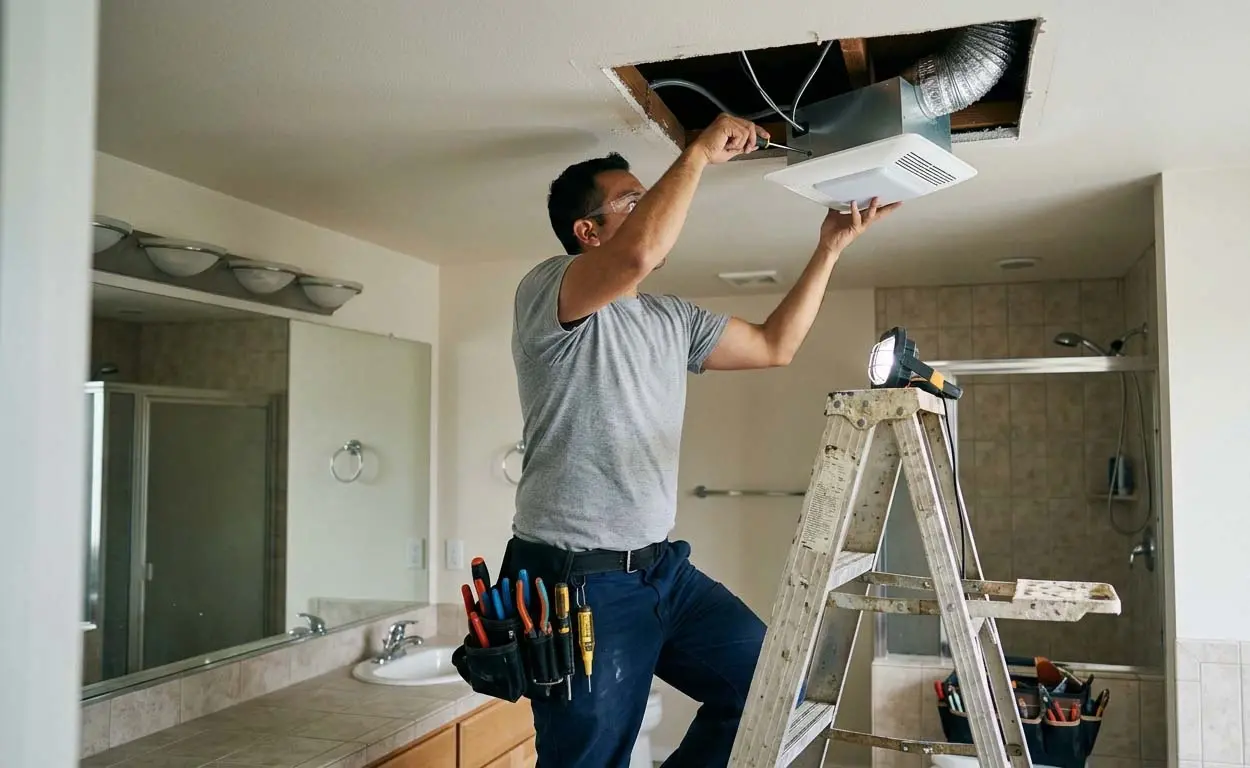
- For retrofit installation, we bring adapter kits that fit new fans into old openings (most common size is 7.5" x 7.5")
- We recommend sone rating based on your tolerance for noise: 1.5 for guest bathrooms, 0.7-1.0 for master baths, 0.3-0.5 for luxury
- We wire humidity sensing fan with automatic override (manual switch still works)
- For bathroom fan with light and heater, we install a dedicated 20-amp circuit (heaters draw 1,500W, too much for shared lighting circuits)
- We test with a smoke pellet — all smoke must exit the outdoor termination within 10 seconds
How Long Does Bathroom Exhaust Fan Installation Take?
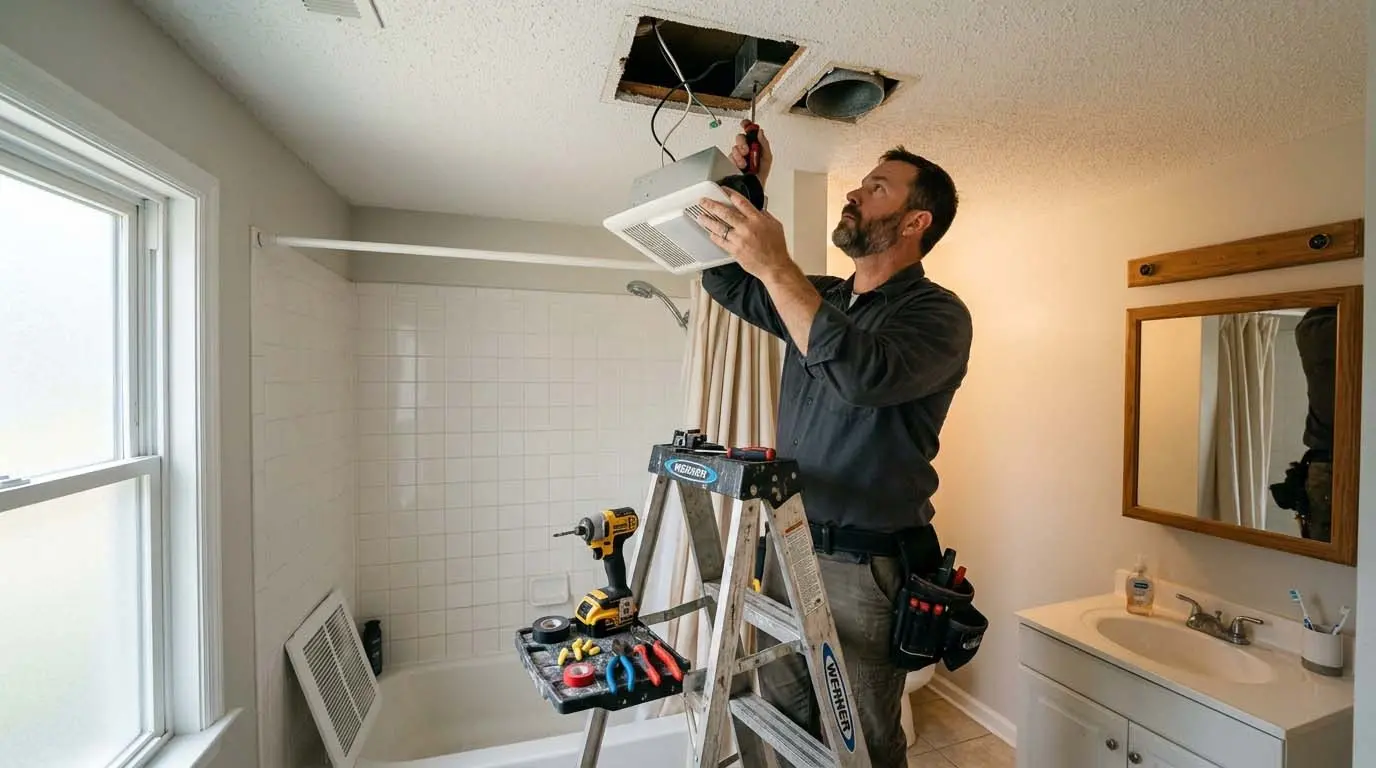
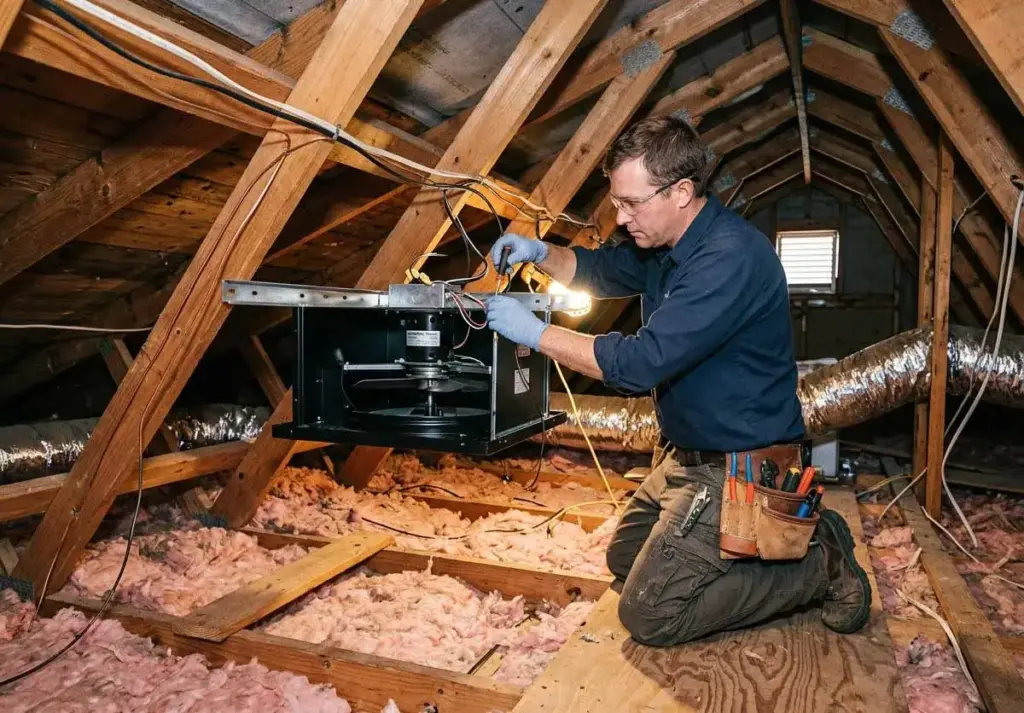
A simple bathroom fan replacement where the new unit fits the existing opening and the exhaust fan ducting is already correctly terminated outside takes 2 to 3 hours. Most of the time is attic work: disconnecting the old fan, removing it, mounting the new housing, reconnecting the duct, and making electrical connections. A retrofit installation where the new fan has a different size than the old hole adds 1 to 2 hours for ceiling modification, blocking, and patching. If your bathroom never had a fan before — no existing duct, no switch, no ceiling hole — expect 4 to 6 hours. We cut a new ceiling opening, run exhaust fan ducting from the fan location to a soffit vent termination or roof cap, fish wire from the switch to the fan, install a new wall switch, and patch the small access holes we cut. A bathroom fan with light and heater unit adds 1 to 2 hours because these units require additional wiring for the heater circuit (often a dedicated 12/2 Romex and 20-amp breaker) and a multi-function switch (light, fan, heater separately controlled). A humidity sensing fan installation where the existing wiring is already present adds 30 minutes for programming the activation threshold (typically 60-70% RH) and run time (20-60 minutes). The most time-consuming scenario in Hollywood is replacing a fan that vents into a finished attic with no existing duct to the outside. We must cut through a gable wall or roof to install a new soffit vent termination, run new rigid duct, seal all joints with foil tape (not duct tape, which dries out), and insulate the duct to prevent condensation. That adds 2-4 hours. We always provide a written estimate with separate line items for fan replacement (fast) vs new ducting (slow) so you understand the cost difference.

Why CFM Rating and Sone Rating Matter More Than Brand Name
Homeowners often buy the cheapest fan at the hardware store or the fan with the brightest LED light. Neither choice fixes moisture problems. The critical numbers are CFM rating and sone rating. CFM rating tells you how much air the fan moves. A fan rated for 50 CFM in a 70 square foot bathroom is mathematically incapable of clearing steam regardless of brand or price. We calculate your actual need: a 40 square foot powder room needs 50 CFM minimum. A 100 square foot master bath with a separate shower and soaking tub needs 110 to 150 CFM. A bathroom with a steam shower unit needs 200+ CFM or a second fan. For exhaust fan ducting, we use rigid metal pipe exclusively. Flexible foil duct reduces airflow by 30-50%, traps lint and dust, and can sag, creating low spots where moisture collects. Flexible duct is also a fire hazard if the fan overheats (metal duct contains fire, flex duct melts). We run 4-inch or 6-inch rigid metal pipe with as few bends as possible. Each 90-degree bend reduces airflow by 30%. We use two 45-degree bends instead of one 90-degree. For retrofit installation, we measure the existing ceiling opening before you buy a fan. Standard openings are 7.5" x 7.5" for older fans. New fans come in various sizes. We either modify the opening or use a retrofit adapter ring. For humidity sensing fan, we explain that the sensor reads relative humidity. If your bathroom has poor airflow in general, the sensor may stay locked on even after the shower cools. We adjust the timeout setting (typically 20-60 minutes). For bathroom fan with light and heater, we install a dedicated circuit because most bathroom lighting circuits are 15-amp shared with other rooms. A 1,500W heater draws 12.5 amps — already 83% of a 15-amp circuit before adding the fan (0.5-1A) and light (1A). Shared with a hair dryer (10-15A) or curling iron (5-10A), you will trip breakers. We run a new 12/2 Romex from the panel, install a 20-amp breaker, and wire the fan, light, and heater to a three-function switch (or two switches if space permits). Every fan installation we complete includes a final smoke test: we place a smoke pellet below the running fan and watch the smoke stream exit the outdoor termination within 10 seconds. If smoke leaks from joints, we seal them. If smoke takes longer than 10 seconds, we improve the ducting or upgrade to a larger fan. We also provide a CFM rating and sone rating card taped to the fan housing for future reference.
Call our ventilation team in Hollywood for a fan that clears steam quietly and reliably. No more foggy mirrors, no more moldy ceilings, no more jet engine noise.